


High-Strength Steel in Vertical and Multi-Story Warehouses
The rise in e-commerce and persistent demand for faster delivery have changed expectations for warehousing. To keep up with consumer expectations, major retailers and logistics companies have been opening fulfillment centers as close as possible to the dense urban areas where most of their customers live. However, urban land is both limited and costly, making the typical sprawling, single-story warehouses found in rural or suburban areas far less practical near larger cities.
What is the solution? To build up, not out. In recent years, industrial developers have been building multi-story distribution centers and vertical warehouses across the U.S., helping companies store inventory closer to customers while maximizing land use and reducing long-term transportation costs.
All of this upward growth relies on steel, which is essential for supporting building structures and the complex racking systems that facilitate efficient storage and automation.
The Difference Between Multi-Story and Vertical Warehouses
Urban distribution centers need to optimize space while streamlining operations for the most efficient outcomes. Two types of warehouses help make this happen: multi-story and vertical.
- Multi-Story Warehouses: Facilitating Access on Every Floor
Warehouses with multiple stories enable distributors and their customers to physically access each floor for storage, fulfillment or processing.
Multi-story warehouse floors must be capable of supporting massive static and dynamic loads from both inventory and equipment. According to the International Building Code and structural standards, upper floors of a multi-story warehouse should be able to support a live load of 250 pounds per square foot (psf) or more to accommodate heavy pallet racking systems and autonomous guided vehicles.
Depending on the design, truck access may also be available on upper floors. Therefore, vehicle ramps must be built to accommodate 18-wheel trucks loaded with merchandise and weighing up to 80,000 pounds (40 tons).
- Vertical Warehouses: Elevating Automation and Efficiency
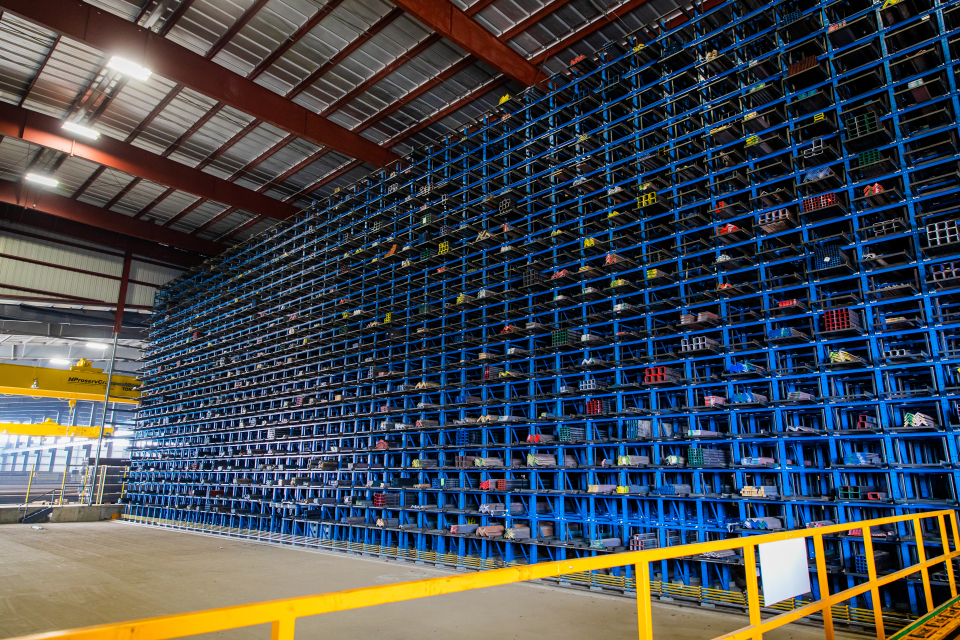
Vertical warehouses (or high cube warehouses) feature high vertical bays to maximize height on a single floor, relying on complex automated systems to store and retrieve goods within tall racking and rack-supported structures.
Because these types of automated distribution centers operate in a single continuous space that can range from 40 feet to over 100 feet tall, building designs and support structures have become increasingly innovative, requiring precision-engineered steel framing for the exterior, along with tall pallet racking systems for internal storage that can safely handle and efficiently store heavy, dynamic loads.
Learn how Nucor is reimagining the future of multi-story warehouses amidst urban development here.
Steel in Racking and Automated Storage and Retrieval Systems (ASRS)
While multi-story and vertical warehouses differ in form, both rely on internal systems for high-density storage — systems engineered using steel. Structural racking and automated handling equipment both depend on steel’s strength to support speed, safety and scalability.
Benefits of Steel Racking
As the primary material in industrial warehouse racks, steel provides durability and the load capacity needed to support heavy products.
- Strength: supports multi-story and vertical warehouses with multi-tiered storage and high-bay shelving, maximizing space without sacrificing stability. Steel’s durability and tensile strength enable these systems to support tons of goods per rack.
- Safety: engineered to meet stringent load-bearing standards and resist seismic events, reducing the risk of structural failure, product damage and worker injury.
- Adaptability: steel structures can be modified, allowing businesses to adapt to changing inventory needs, seasonal demand or expansion.
- Customization: it can be fabricated with precision, allowing for unique configurations and easy integration with automation systems such as pallet shuttles, mini-loads, conveyors, robotic pickers and inventory-tracking sensors.
The flexibility of steel rack storage enables structures like warehouses and distribution centers to adapt to technological and market changes without a complete infrastructure overhaul. Unlike other materials, high-strength steel maintains its integrity under extreme stress and over long periods, making it both a practical and economical long-term investment.
Steel in ASRS Systems
Automated storage and retrieval systems (ASRS) are computer-controlled systems that store and retrieve goods from defined warehouse locations and offer the benefits of increased efficiency, reduced worker fatigue and improved inventory management. Much of this automated equipment is built from high-strength and/or cold-formed steel because it provides the dimensional consistency and long-term durability necessary for reliable operations.
The ASRS market is anticipated to grow 8% from 2025 to 2030 (Grand View Research). As the demand for automated storage rises, so does the need for high-strength steel.
Structural Steel: The Backbone of Innovative Warehouse Construction
Warehouse design is driven by a simple challenge: how to economically enclose a large space to use for storage. Structural steel delivers the strength and efficiency that modern multi-story and vertical warehouse projects demand. With the growing demand for taller, load-intensive structures, steel is an ideal material choice due to its ability to resist fatigue and allow for future adaptive reuse.
Open-web steel joist floor and roof systems provide engineers with long-span flexibility to optimize column spacing, clear heights and unobstructed aisles. In roof applications, steel deck acts as a structural diaphragm that distributes gravity loads, stabilizes the framing, and efficiently transfers lateral forces to the building’s lateral force-resisting system. In floor systems, composite metal deck and concrete topping work together to create a stiff, load-sharing slab that enhances strength, vibration performance, and constructability while providing a durable, level surface. These integrated joist-and-deck systems deliver efficient structural performance as spans and loading requirements increase.
While steel makes long spans achievable, high-strength steel grades can reduce member sizes and enhance structural performance within those span ranges. With fewer columns throughout the structure, floorplates become more efficient for racking, automated systems and high-traffic equipment movement. Spans of 40 to 60 feet, once difficult with conventional materials, are now practical and reliable.
For example, Aeos® ASTM A913 Grade 65 steel features higher strength with reduced tonnage for large construction projects. Its superior strength-to-weight ratio enables it to carry heavier loads with lighter members, reducing overall steel tonnage by up to 20% while still supporting long spans and multi-level load transfers.
Learn more about how Aeos reduced tonnage and embodied carbon in the Novo Nordisk greenfield expansion case study.
Other reliable products for warehouse systems include structural steel, C-channel and Nucor’s proprietary TubeRack solution, which is seismically rated and can be used anywhere across the U.S.
Building a More Sustainable, Reliable Supply Chain
Reducing a warehouse’s embodied carbon footprint is an increasingly important focus for owners, logistics companies and their customers.
Steel buyers can benefit from using American-made circular steel, which uses recycled steel scrap as its primary feedstock and is produced in electric arc furnaces (EAFs). Because high-strength steel reduces overall project tonnage, it also lowers embodied carbon and transportation emissions.
Domestic steel benefits projects through:
- A dependable supply chain that aligns production scheduling with fast-moving warehouse construction timelines.
- Consistent quality and predictable performance to meet tight tolerances.
- Reliable fabrication outcomes supported by precision and advanced mill technology.
- Full compliance with ASTM and AISC standards, reducing specification risk and easing approvals.
American high-strength steel is the foundation of the next generation of efficient, sustainable warehouse infrastructure, designed to meet modern logistics demands while supporting a circular economy.
Contact Nucor to learn more or inquire about your next warehouse project.