


Improving Local Formability in Automotive Steel

Modern vehicle platforms rely on advanced sheet steels to meet growing demands for weight reduction, crash performance and fuel efficiency. As automakers and OEMs move toward higher-strength grades, alloying strategies become more complex, and stamping those materials into finished parts becomes more demanding. No individual characteristic fully explains how a sheet steel grade will perform on the press line.
The Global Formability Diagram is often used to show the total elongation relative to the tensile strength of various steel grades. While useful overall, it does not predict how steel behaves along a cut edge, which is where cracks often initiate in the stamping process. This is where understanding local formability becomes essential.
What is Local Formability?
Edge cracking during stamping is a relatively modern problem. Historically, stamped automotive body parts built during the 1950s-70s relied mostly on mild steel, a low-carbon, malleable material that naturally stretched easily at a cut edge. With technological advancements, automakers shifted to significantly higher-strength grades to fulfill increasing needs for weight reduction and crash safety. As a result, stretching a trimmed edge became more difficult, and local formability became a critical constraint in automotive stamping. Therefore:
- Global formability addresses the stretch and draw forming limits of a material before failure from overall thinning, or “necking,” of the steel.
- Local formability emphasizes concentrated failures, where cracking occurs in specific areas of a cut steel edge or a stretched tight radius bend.
As sheet steel grades continue to advance, fabricators have learned to consider new factors in global vs. local formability for designing and stamping automotive parts, because a sheet steel grade might pass conventional tensile test requirements but still develop edge cracking during stamping.
For instance, advanced high-strength steel (AHSS) grades were developed to solve specific automotive needs, featuring high ultimate tensile strength with improved global formability for crash-energy absorption and intrusion protection compared to high-strength low-alloy (HSLA) steels.
However, some AHSS grades can present local formability challenges, leading to edge splits and fissures. Their properties, such as increased work hardening and high strength, can cause localized strains that increase the risk of cracking at cut edges.
This challenge varies among AHSS grades; for example, dual-phase (DP) steel and other grades may be capable of providing versions with improved local formability. The key difference lies in the steel’s microstructure and cleanliness rather than the grade category alone, which is a determining factor for OEMs considering stamping performance.
Conventional software can readily model global formability to identify potential formability issues; however, local formability is harder to simulate accurately because many factors can influence it, from microstructure to edge quality and stamping parameters. As a result, local formability splits may become unpredictable when steels are trimmed under less-than-ideal conditions that can occur in standard production.
How the Microstructure of Steel Influences Formability
Picture two coils of the same grade that meet the same chemistry specification and mechanical properties, including yield strength, ultimate tensile strength and elongation. Both are loaded onto the same press and run through the same die. One stamps thousands of parts without incident; however, the other coil starts splitting at the flange edge before the run is halfway through.
Nothing listed on the mill certification explains the difference because it only validates that the material is within specification and does not specifically identify how the steel will respond when it is trimmed and stretched. The answer may lie inside the steel itself.
The steel’s composition, grain shape and size, phases and inclusions can significantly influence how the material responds when a trimmed edge is stretched. Two coils in this example may share identical reported mechanical properties and produce deeply drawn parts without issues, yet they can behave very differently along trimmed edges that are stretched during stamping because the reported mechanical properties mainly reflect global formability rather than local formability.
Edge crack resistance is largely determined by the microstructure of the steel.
By the time a coil arrives at a stamping press, its microstructure and much of its edge performance are already determined by how it was produced. Metallurgists must look beyond the typical mechanical properties reported in a mill certification and into the steel microstructure when diagnosing edge-cracking issues. Therefore,
- A uniform, fine-grain structure with consistent phase hardness resists cracking.
- Non-uniform grain size and orientation, larger grains and the presence of less ductile phases and inclusions provide cracks with an easier failure path.
Nucor’s high-quality steelmaking practices at its electric arc furnace (EAF), ladle metallurgy furnace (LMF) and thin slab casting facilities produce calcium-treated steel sheet with very low sulfur levels. This treatment modifies jagged manganese sulfide inclusions into a more desirable globular shape and floats many of these inclusions out of the molten bath, thereby improving local formability. If not controlled, these inclusions provide preferred pathways for cracks to follow.
By implementing a low-carbon chemistry, appropriate micro-alloys and the correct balance of alloy additions, Nucor produces world-class, automotive-grade steel sheet products that meet required mechanical properties and have a uniform, fine-grained microstructure that results in the higher toughness ideal for improved local formability.
In contrast, steel mills using a blast furnace-basic oxygen furnace (BF-BOF) and thicker slabs often achieve strength on their HSLA grades through higher carbon content, which results in steel sheet with more pearlite, resulting in a microstructure that is harder and less ductile than the surrounding ferrite, creating a difference in ductility that makes it easy for edge cracks to propagate during stamping.
| High-quality microstructure | Poor microstructure |
| Fewer edge cracks during stamping | Split edges |
| More consistent production | Production delays |
| Potentially reduced die maintenance | Additional inspection |
| Fewer stamping disruptions | Potential line stops |
| Lower OEM manufacturing costs | Potential launch delays |
| Fine grain size, ferrite (HSLA) | Ferrite/pearlite, reducing edge ductility (HSLA) |
| Uniform, equiaxed grains | Banding (long, stretched grains) |
| Uniform microstructure | Alloy segregation |
| Low inclusion content, modified sulfides | Inclusions, unmodified sulfides |
| Fine-grained martensitic islands (DP) | Larger martensitic islands (DP) |
Grades with Improved Local Formability
In general, mild steels produced at all steel mills have excellent edge stretchability. They are highly ductile grades with uniform, ferritic microstructures.
The local formability advantages of Nucor’s grades fall within the higher strength grades:
- High-strength low-alloy (HSLA): Due to their fine-grained, low-carbon, solid-solution-strengthened ferritic microstructures, these grades exhibit excellent edge stretchability.
- Dual phase (DP): Characterized by uniform, fine-grained, low-carbon ferrite and martensite microstructures, Nucor’s DP grades are recognized as best-in-class.
- Multiphase and complex phase (CP): A consistent, fine-grained multiphase microstructure and alloy composition contribute directly to their superior local formability. Besides having improved hole expansion properties, Nucor’s hot-rolled multiphase grades have superior resistance to cut edge fissures (also known as side splits after stamping).
How Trimming the Edge Affects Local Formability
Troubleshooting local formability issues requires examining the edge to determine if it was trimmed correctly. Even the highest-quality steels produced with excellent local formability can develop splits if the edge is improperly trimmed.
Mechanically trimming steel induces cold work (when a metal is shaped at a temperature below its recrystallization point) to a depth of approximately half of the material thickness, which reduces the steel’s original stretchability along that trimmed edge before it ever reaches the press.
Variables in edge quality:
- A trimmed edge has four zones: rollover, shear, break and burr.
- The rollover is the deformed region just before the trim tooling penetrates the steel.
- The shear (or burnish) zone is where the trim tooling comes in physical contact with the steel as it shears through it.
- The break (or fracture) zone is where the material fractures rather than cuts.
- The burr is the last remaining portion connecting the two trimmed pieces that is eventually pulled apart.
- An ideal edge is generally comprised of 30% shear and 70% break with minimal burr and rollover; however, this can vary based on material strength and die clearance.
- The burr height and burr direction matter because the burr acts as an initiation site for fracture to occur. A tall or misdirected burr concentrates stress at the edge and can sharply reduce stretchability, even when the rest of the trim looks acceptable.
- An off-ratio edge compounds risk; if the shear-to-break ratio drifts, stretchability drops more sharply. A consistent shear-to-break ratio is key.
Achieving an ideal trim requires sharp, well-maintained tooling and proper trim clearances. Unpredictable production conditions on the stamping floor often affect both, which is why local formability remains difficult to model and predict with computer software. As a result, evaluating edge trim quality is also very important when diagnosing edge cracking issues.
How to Test Local Formability
Unlike tensile strength or hardness, there is no industry-wide test with consistent values for local formability. The automotive industry continues to research methods, and hole expansion testing (HET) has emerged as the most widely recognized tool.
The HET measures the hole expansion ratio (HER) by punching a 10 mm hole into a sample, then expanding it with a 60-degree conical punch until a through-thickness crack appears, called a failure point. The percentage increase in the hole’s diameter is the HER, and the method is standardized under ISO 16630.
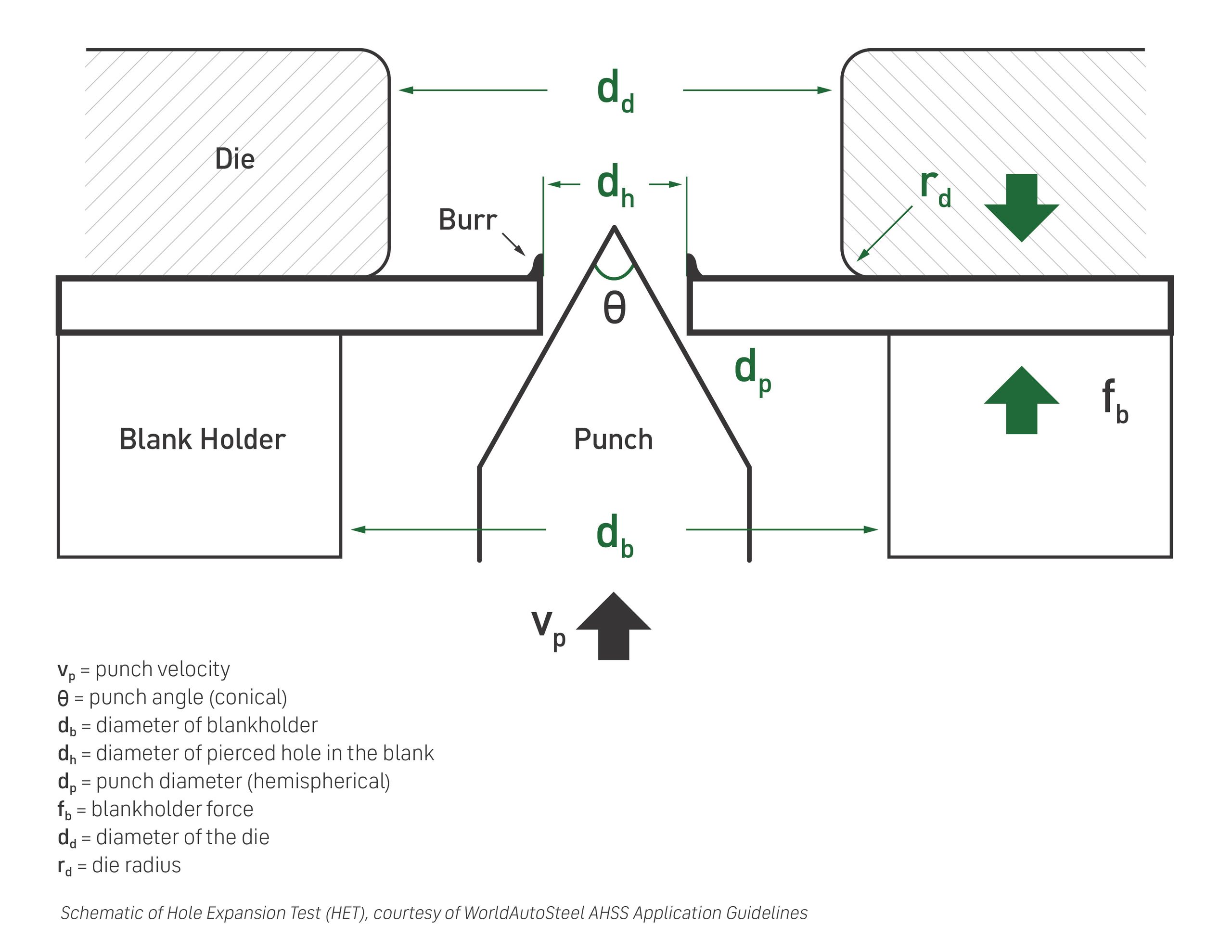
Schematic of Hole Expansion Test (HET), courtesy of WorldAutoSteel AHSS Application Guidelines
Even with a standardized procedure, results can vary widely, sometimes even among samples cut from the same coil. The punching method impacts the HER, so testing requires sharp tools and techniques that create clean edges.
Timing between punching and testing
HER results can also be affected by the timing between when the hole is punched and when it is stretched. HER results tend to be lower if the hole is stretched several hours after it is punched than if it is stretched immediately after punching.
- At some test facilities, punching and flaring the hole happen on the same equipment, so samples often sit between the two steps while the equipment is reconfigured. That time delay was found to affect the results.
- The same principle holds on the production floor: forming a part shortly after blanking preserves edge stretch, whereas a blanked edge that remains idle for even a few hours tends to set and stretch less than a new edge.
As a member of the Auto/Steel Partnership (A/SP), Nucor maintains its collaboration with the organization where work is performed to find ways to reduce the variability of hole expansion test results. A/SP has established standardized test procedures to facilitate uniformity of testing results across the industry.
Methods to improve edge stretch in stamping
- Die clearance: Typically, clearance is around 10% of material thickness, though AHSS grades often require more. Excessive clearance increases burr formation and edge damage during blanking.
- Grade selection: Select a grade with a microstructure that matches the edge-stretch requirements of the part, rather than solely relying on its strength requirement.
- Sharp tooling and trim edge quality: Worn or dull tools cause work-hardening and damage the cut edge, making cracks easier to initiate and propagate. Sharp, well-maintained tools leave a cleaner, more uniform edge.
- Milled edge: Machining the sheared edge after blanking removes the work-hardened layer left behind by a stamped or sheared edge. This is not practical for typical production, but it is a known method to improve edge stretch.
- Heat: Warming the edge prior to forming may enhance ductility, enabling greater stretch before cracking.
- Minimize time between blanking and stamping: A freshly blanked edge stretches more effectively than one that has been sitting, even for a few hours.
- Avoid concentrated edge thinning during die design: Distributing strain along the edge, rather than concentrating it in one spot, reduces the likelihood of a localized crack.
The Importance of Consistent and Transparent Testing
Because hole expansion testing results vary so widely, analyzing results across more than one lab is an effective way to validate local formability across a manufacturer’s steel grades. Nucor participated in a steel industry round-robin hole expansion test several years ago, and the results were statistically similar to those of the other mills.
Nucor continues to apply this methodology through internal round-robin testing at its automotive sheet mills, where the same material is tested independently on each of Nucor’s three facilities with hole expansion test machines, and results are compared for consistency. They also plan to expand this round-robin testing to downstream customers, ensuring the supply chain relies on a shared, credible foundation for interpreting local formability data.
Nucor’s testing practices:
- Consistency: Local formability is evaluated across multiple advanced-grade sheet mills, including Nucor Steel Berkeley, Arkansas and Gallatin, to ensure results are comparable regardless of which mill produced and tested the sheet.
- Investment in testing technology: Nucor continues to invest in advanced technology, including high-resolution cameras to detect crack initiation at several of its test facilities.
While high-quality steel with a uniform microstructure gives Nucor’s automotive sheet grades their edge stretch performance, customer satisfaction and transparent testing verify that performance.
Local formability is not determined by a single factor. It results from metallurgical design, manufacturing practices, edge quality and accurate testing working together to improve forming performance.
Nucor’s automotive team is proud to offer dedicated technical support and ongoing solutions that are accelerating the transition to more sustainable automotive production through innovative steel sheet and bar products.
Posted